On Holocaust Remembrance Day, this twitter account is posting the names and photos (when available) of refugees turned away from America who became victims of Naziism. #NoBanNoWall #RefugeesWelcome
(Please leave this caption in place.)
In 2012, the last year of recorded data, developing countries received a total of $1.3tn, including all aid, investment, and income from abroad. But that same year some $3.3tn flowed out of them. In other words, developing countries sent $2tn more to the rest of the world than they received. If we look at all years since 1980, these net outflows add up to an eye-popping total of $16.3tn – that’s how much money has been drained out of the global south over the past few decades. To get a sense for the scale of this, $16.3tn is roughly the GDP of the United States. What this means is that the usual development narrative has it backwards. Aid is effectively flowing in reverse. Rich countries aren’t developing poor countries; poor countries are developing rich ones.
I haven’t quite thought this out enough to have my thoughts totally clear, but I usually clarify my thoughts by writing them down, so I’m gonna try it anyway. For context I am writing as an ethnically Jewish white person.
I have seen some Discourse where person A says something like “We can’t dehumanize the people we’re fighting,” and then Person B goes “Yeah, this was why we shouldn’t have punched that Nazi!” and then Person C goes “Uh, we have to punch Nazis,” and then Person D says “Nazis aren’t people!” and then the whole Discourse Cycle starts up again.
The problem, I think, is that we are taking “don’t dehumanize” as code for “be nice to?” And that’s not what it is. “Don’t dehumanize” means understanding there is not a profound difference between yourself and a person who believes something repugnant. Otherwise, it becomes too tempting to think that a repugnant belief is some kind of monstrous mental defect that we get to just magically Not Have, because we – after all – are people, and Nazis are Not People.
If we believe that we are immune to repugnant beliefs, we become incredibly vulnerable to them. Sorry if I’m being redundant here, but I really want to spell this out: If we think that Nazis aren’t people, we open a door that is going to kill our ability to be useful, effective, intersectional activists. We will absolutely become complacent. Beliefs will creep up slowly in our brains, because that’s what brains do, they gather information and make just whatever crap soup out of it, and we – if we sense the development of these ideas at all – will go “Well, this must NOT be a repugnant belief, because only Not-People have repugnant beliefs, and I am a Person!”
And again, that’s not synonymous with saying that “If you want to punch Nazis in the face YOU’RE JUST AS BAD AS THEM!!!!” That’s crazy and garbage. It’s also not synonymous with “We have to tolerate Nazi beliefs!” I am trying to make a pretty straightforward statement that Nazis are people. They are people, and we have to look that fact dead on, and then we have to punch those people in the face, hard and often.
“They are people, and we have to look that fact dead on, and then we have to punch those people in the face, hard and often.”
“that’s a made-up term!” yes. so are all terms. so is every word ever. language is constructed. that’s how language works. stop unevenly invoking the constructed nature of language to try to stop marginalized people from better representing their experiences and identities.
like, when you say “that’s a made-up term!” we all know what you actually mean is “that term was made up by people i don’t think should be allowed to have a voice"
For the past week, Naked Capitalism has run a series of articles by transportation industry expert Hubert Horan on the economic shenanigans of Uber, which cooks the numbers it shows investors, drivers and the press to make it seem like something other than a black box that uses arrogance and lawlessness to make a bet on establishing a monopoly on transport in the world’s major cities.
I really can’t recommend these articles enough, this is a fantastic series of articles on Uber’s economic model and the dangers it poses. A quick synopsis: Uber is the world’s most valuable private company, valued at $69bn. However, it has yet to make any money – in fact, it’s lost $4bn over its 4 year history history, and lost $1.2bn this year. The reason for its losses is that its taxi rides are kept artificially cheap along with large subsidies paid to drivers to attract them from other taxi firms. The price of an Uber covers only 41% of the cost of a ride. For all the guff, Uber’s economic model is not particularly innovative and probably would never be profitable without these investor subsidies. I recommend reading the 4th part the most, as it reveals why sillicon valley investors are pouring cash into a business model that would never be profitable in a competitive market. The goal is to use these subsidies from sillicon valley’s deep pockets to drive local taxi services out of business and turn established, well regulated market into an unregulated monopoly in the hands of big capital. Once this monopoly is established, Uber can cut the subsidies, determine prices at will without the constraints of existing legislation, and generate a lot of value for the original investors. Rather than the future sharing economy, Uber instead represents a new wave of accumulation by dispossession.
fuck uber
#fuck uber
Again, in bold:
The goal is to use these subsidies from sillicon valley’s deep pockets to drive local taxi services out of business and turn established, well regulated market into an unregulated monopoly in the hands of big capital. Once this monopoly is established, Uber can cut the subsidies, determine prices at will without the constraints of existing legislation, and generate a lot of value for the original investors. Rather than the future sharing economy, Uber instead represents a new wave of accumulation by dispossession.
Don’t use Uber.
I didn’t have time to comment when I queued this, so here it is again.
I’ve used Uber three times – once in NYC as part of a large friends group being ferried around, once in London for several reasons (including figuring that I should at least test use the app myself), and once last week, when I was caught out with only $15 so someone else called one for me. I’d intentionally resisted using it, but not because I considered it rigorously. As an adult city dweller who has never owned a car and remembers the rigmarole being peddled during the first dot-comm boom, it just seemed like an obviously bullshit business proposition. I thought it was a ploy to circumvent regulation and shift both risk and cost to employees and consumers (historically, surge pricing was one of the major pitfalls regulation was designed to prevent! bc timing of taxi demand is inelastic!!! you don’t need an algorithm to make surge pricing happen bc w/o regulation on both pricing and geographical coverage it will happen naturally as a result of market forces!!!!).
Anyway, I did remember that not everyone has taken business/econ classes, but. The app is good and I’m sure it was impressive in 2014 but now the big trad dispatches in Montreal all have similar smartphone functions. I would guess it’s similar in other cities, because adapt or die.
Companies always try to circumvent regulation and pass off risk/cost if they can, but these articles are good because they really shake out every predictable impact to the system. And all of it is entirely predictable.
More importantly, Uber’s surge pricing reduces overall economic welfare because the sociological distribution of urban taxi demand is bipolar; 43% is from people earning less than $20,000 (and 55% from people earning less than $40,000), most of whom do not have cars while 35% is from people with incomes greater than $100,000.[10] Studies show most of the lower-income demand is driven by jobs and services that cannot easily be reached by public transit, or trips at hours when public transit does not operate. Surge pricing reduces wait times for wealthier people returning home from restaurants and nightclubs by eliminating all service for lower income people working late night shifts that have no transit options. A pro-Uber paper by a major libertarian think tank simply dismissed these as “people who do not really need a ride.”
It’s a glorified dispatcher service that screws over drivers because unlike traditional dispatchers, uber doesn’t have to take any liability, insurance, pay roll, or other care (such as it is) of their drivers or the vehicles.
I’ve gotten into fights with people about Uber before because I refuse to use it. I’ve always suspected that they were intentionally moving to drive legitimate competition out of business.
But mostly I won’t use them because frankly I think it’s fucking dangerous. I don’t climb into cars of strangers. Drivers that work for taxi companies are hired. They are bonded and licenced and carefully tracked. Not many people I know have had bad experiences with a taxi driver other than one being annoying or a little weird. I had a friend take an Uber with a guy who started driving her way off course to her home and only started to actually take her home when she got on the phone with her mother and had her talk her the entire way back.
For me, taking an Uber is like fucking hitchhiking. Most people who drive you aren’t going to hurt you but all it fucking takes is getting into the wrong car.
Everything about Uber skeeves me out from the concept to their economics.
I told friends here that I don’t do Uber; all of the above is why. I’d also much rather support the legit taxi drivers here, who are bonded and licensed (and maybe unionized? I’ll have to look into that). I trust them, both with my money and with my home address. I don’t trust Uber with that information.
There’s also that friends of mine who have service dogs have been repeatedly stranded by Uber, Lyft, etc.
If you want to see the alternative to Uber in action, here is an article about how unionised taxi drivers in Austin drove Uber and Lyft out of the city and replaced them with a worker-owned co-op (the third largest in the US). As this article argues, given that most of the capital used to run Uber comes from the workers themselves, it would be very easy to generalise this model and turn Uber into a worker controlled enterprise, and use tech which is currently being used to undermine both wages and security for the benefit of both workers and passengers.
Never shall I forget that smoke. … Never shall I forget those flames that consumed my faith forever. Never shall I forget the nocturnal silence that deprived me for all eternity of the desire to live. Never shall I forget those moments that murdered my God and my soul and turned my dreams to ashes. Never shall I forget these things, even if I were condemned to live as long as God himself.
Never.
Elie Wiesel, Night
–
All the Dachaus must remain standing. The Dachaus, the Belsens, the Buchenwalds, the Auschwitzes—all of them. They must remain standing because they are a monument to a moment in time when some men decided to turn the earth into a graveyard. Into it they shoveled all of their reason, their logic, their knowledge, but worst of all, their conscience, and the moment we forget this, the moment we cease to be haunted by its remembrance, then we become the gravediggers. Something to dwell on and remember…
Rod Serling, The Twilight Zone, “Deaths-Head Revisited”
When Soviet troops arrived at the Auschwitz concentration camp on the 27th of January, 1945, they found roughly 7,500 living prisoners–most of whom were weak, ill, and starving–and hundreds of corpses. Though the camp remained largely in tact, the retreating S.S. had demolished several buildings, including the gas chambers, in an attempt to hide their crimes. Overall, an estimated 1.1 million people were murdered in Auschwitz between 1940 and 1945, making it the most deadly of all the Nazi concentration and extermination camps. The majority of the victims were Jews.
Auschwitz-Birkenau became a museum in 1947, and the UN appointed January 27th as International Holocaust Remembrance Day. Seventy years after its liberation, Auschwitz remains the dominant symbol of the Holocaust
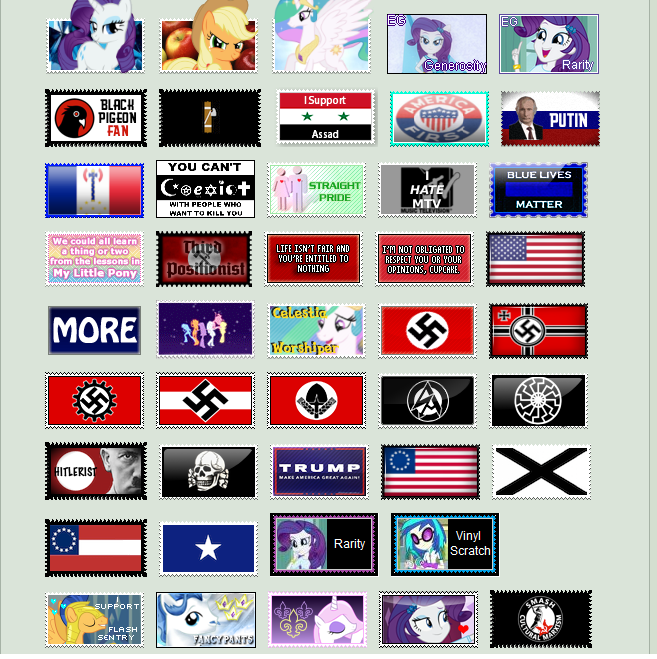
i found this dudes deviantart page and i honestly don’t know how there are people who base their entire identities around nazism and my little pony like we don’t even have to make jokes about these people because they make the jokes themselves
I realize most people on here are too young to remember the Bush years but when you guys frame your SJ posts as “you hate[x]!!! why do you hate [x]???” it sounds an awful lot like how Bush supporters would scream WHY DO YOU HATE AMERICA???? whenever anybody would criticize the president.
So that’s something to consider if you want to reach people over 25. Because most of us have an extremely negative conditioned response to that type of rhetoric.
Yeah.
There’s a surprisingly sharp generation gap on Tumblr–when I first got on the site in 2011 it was between high-school age and college age, but I don’t think it’s defined primarily by life stage or maturity level, because it’s tracked steadily upward ever since. Anecdotally, right now the split seems to be centered around age 23, plus or minus a couple of years on either side, which corresponds roughly to the birth years 1990-1994. My hypothesis for the generation gap boils down to “how old were you on September 11, 2001?” Those solidly on the older side of the gap were at least vaguely aware of a pre-9/11 political landscape, witnessed how disruptive the first term of the Bush administration was, and have a visceral reaction anything that smacks of neoconservatism or Religious Right propaganda. Those on the younger side attained political awareness in a world where the changes wrought by the Bush administration were the new normal, and their right-wing bogeyman uses Tea Party and GamerGate rhetoric.
So for the record, Bush-era “innovations” that unnerve the FUCK out of people on the older side of the generation gap:
– Casual acceptance of fear as an excuse for hatred and pre-emptive retaliation
– An “ends justify the means” approach to stamping out the slightest trace of vulnerability, no matter how repressive the means, or how slight or unlikely the potential harm
– “If you’re not marching in lockstep with us, you’re one of THEM, why do you hate all that’s good and noble?” / “Dissent and safeguards against the abuse of power just give aid and comfort to the enemy” / “Don’t you SEE that insisting that the protections of civil society apply to THOSE PEOPLE is just going to GET OUR PEOPLE HURT, YOU’RE HURTING PEOPLE YOU MONSTER”
– Anything that smacks of religious-fundamentalist logic or rhetoric
These things are not normal. These things are not how just societies are built. They are the hot water that an entire generation of lobsters has been raised to swim in without noticing. The undercurrents in the internet movement calling itself Social Justice that disturb the older generation are, essentially, the dirty tactics of the Bush administration and its unholy marriage of neocons and fundies–rebranded with a new set of acceptable targets, but with the tactics themselves unquestioned. Are they the younger generation’s fault? Fuck no. They’re what happens when the most culturally and politically powerful nation on Earth tries to pretend it’s moved on from the Bush years, but without ever having confronted the devastation those tactics left in their wake, dismantled the self-sustaining fear-and-repression machine, or held the perpetrators accountable for their officially-sanctioned torture, shredding of civil liberties, and thinly-justified wars of aggression.
So if I were to do the annoying geezer thing (at the ripe old age of 27) and Address The Youth, I guess what I’d say isn’t just that most people over 25 get an overwhelming urge to throw up in their mouths at the slightest sign you’re playing “but why do you hate freedom” Mad Libs. (Although that’s true.) It’s more than that. It’s that “why do you hate [x]???” belongs to an entire toolbox of fear/attack, ingroup/outgroup, and absolutist tactics that we’ve left lying out without bothering to re-affix the giant warning labels that they aren’t normal, or necessary, or even effective over the long term, however tempting they may be for a quick fix. And that it’s okay to refrain from using them.
The bad guys will not win if you ease off the attack a little and give your opponents room to tell you where they’re coming from. Opening yourself up to argument-counterargument with Bad, Unacceptable, Forbidden ideas is a form of vulnerability, but finding and evaluating the weak spots in your beliefs ultimately strengthens them and strengthens your ability to win people over to your side. Doubling down on the repeated assertions that you shouldn’t even have to argue and that disagreement is harmful or immoral is an alluring way to get what you want in the short term, but it produces superficial compliance out of fear rather than genuine agreement, and the backlash it causes is ultimately more dangerous than the vulnerability of opening yourself to disagreement. And it blinds you to the possibility that you may not be entirely in the right. This isn’t some MRA sneak attack to manipulate you into ceding ground. This is how discussion normally works in a functional society. You have been handed a dysfunctional, toxic system for exchanging ideas, in online SJ as well as in wider politics–and no, it’s not normal or effective, and no, you do not have to buy into that system’s claims that it’s the only thing standing between the innocent and an orgy of destruction and victimization.
The strangest thing about this is that I would not consider myself particularly old (does anyone?) but I was in my late teens on 9/11, and yeah. This is exactly what I find unnerving about the approach of some younger people to SJ issues. For a long time I just put it down to (im)maturity, but I’m really starting to think that there’s something fundamentally toxic and broken about the way our country has been approaching these things for the last 15 years or so. That kind of black and white, ‘if your fave is problematic then they’re basically the antichrist’ thinking that demonizes and squashes any kind of disagreement is really unhealthy, and it’s something that is learned.
Same, I’m 30, married to someone older than me, and we have a lot of friends in their 40s/50s. People I encounter on a regular basis comment on what a “baby” I am. I was 15 on 9/11. I’m not like. Ancient. But there is a definitely a difference between how people my age discuss issues versus how younger folks discuss them. Neons have really done a number on out ability to talk about stuff.
This would explain a lot about how fandom conversations have been going down recently. The absolute us/them nature of some of them, and the way SJ tools are used to bully people in order to win an argument.
I thought it was largely to do with Tumblr being a poor design for actual conversation, but this makes more sense, given the patterns I’ve seen.
I…think that most of the people on Tumblr will get older. The no holds barred, right or wrong, FUCK YOU surety is part of being a teenager. Then you get it knocked out of you and learn to nuance. Both phases have value. What I’m saying here is that I think it’s more developmental than generational.
I don’t understand what this has to do with 9/11
9/11 largely serves as a convenient symbolic marker for a severe shift in public discourse– I was 14 when it happened and I very clearly remember the before-times socially and politically and the after, when there really was a huge public shift in the way things were discussed, and how people in my age group and a little younger responded to things like “national tragedies,” “us vs them,” good vs evil" etc?
Kind of dumb example but I think is illustrative– when we were 12/13, the year before 9/11, a group of kids went to DC and New York and visited all the war memorials. People whose uncles and fathers had fought in Vietnam visited the wall and Arlington, were moved, went through all the ceremonial stuff, but not to the point of dramatic hysterics. Maybe two/three years after 9/11, many of the same kids went to Pearl Harbor while we were on tour in Hawaii and everything was prefaced with this really jingoistic Us Vs Them language, and half the group spent the entire time bawling performatively. There were also a lot of recriminations for not engaging in the theatrics, because it wasn’t showing Proper Respect to Our National Heroes, none of whom any of these kids could have known because they all died in 1941.
My little brother is only 22 months younger than me but he doesn’t really remember the day at all, and doesn’t really remember anything about the politics or big news stories from beforehand, whereas I very clearly remember having an opinion about the 1996 election and my The Talk with my mom was kicked off because of the Clinton impeachment. 9/11 kicked off a lot of the worst of what we see in American political discourse today, and so people who don’t remember it as clearly or the time before may have different outlooks, especially in the States.
On the one hand this is a fairly enlightening take on the somewhat rabid state of what passes for online discourse these days.
On t’other, remind me again why we haven’t built a wall around America yet?
This is a fascinating conversation. I think there’s more to it than this–the way digital social spaces intersect with social phenomena informs the discourse hugely–but there’s a lot here worth considering.
It also occurs to me that a lot of us who were old enough not only to remember 9/11, but also to be aware of the shift in public discourse around it, are also old enough to remember the Cold War, or at least its last lingering throes.
I’m 32, and I grew up with parents who were very active in the nuclear freeze movement. One of the fundamental truths I absorbed very early was that us-vs.-them absolutism and refusal to compromise and engage in good faith with ideological opponents wasn’t just stupid; it was deadly–potentially on a massive, global scale. I remember projects to hook U.S. kids up with penpals in the U.S.S.R. in hopes that we’d learn to see each other as people and so maybe not end life on fucking Earth if by some miracle our parents didn’t beat us to the punch.
And that approach was critical to the peace movement in general: humanizing the enemy. Trying to find points of connection; to learn to disagree humanely. That was a core, fundamental value of my childhood, in ways that were very closely and directly linked to the contemporary geopolitical scene; and they’re philosophies that continue to profoundly inform and steer my discourse and my approach to conflict–personal and political–as an adult.
Which is part of what scares the shit out of me about the discourse I see online, especially from the left: it’s all about radical dehumanization. I see people who are ostensibly on my side casually call other human beings trash or garbage or worthless. Scorch earth. Go to unbelievable lengths to justify NEVER engaging. Meet overtures to peace or steps toward change with spectacular cruelty.
I mean, I’ve seen variations on this exchange more times than I can count:
“[group x] are people, too.”
“No, they’re not.”
And then people LOL, and I don’t even know where to start, because–No. You do not say that. You do not EVER say that. EVER.
And I can so easily imagine how terrifying it must be to grow up in that–to be 15 or 16 or 17 and just becoming, and trying to find and place and grow into yourself in that kind of violence, and–
–to paraphrase someone profoundly and complexly flawed and still a person worth paraphrasing: Remember, babies, you gotta be kind.
Rachel is so very, very spot-on here.
There’s a lot of good stuff here, and part of what it boils down to, especially with regard to fandom, is:
1) “This piece of media upholds a status quo or supports a position that marginalizes people” != “This piece of media is worthless and anyone who likes it is a horrible human.”
2) The flipside of the above, which is “I like this piece of media” SHOULDN’T = “This piece of media is perfect and I will shut up anyone who criticizes it.”
It’s okay to like problematic things. It’s okay for other people to like problematic things.
It’s not okay to say that because you like something, it’s not problematic and people can’t talk about how it’s problematic.
It’s also not okay to say that because something is problematic, other people can’t like it, that they’re wrong to see things that speak to them in it, etc. (Note: I’m not talking about if the problematic elements THEMSELVES are what they like.)
I just thought I might add something to this conversation from the other side, since I was 1 when 9/11 happened. I can’t remember what the country was like before Bush, I can barely remember the Bush administration itself, and when I was reading earlier in the post one of the things that hit me hardest was the line:
Opening yourself up to argument-counterargument with Bad, Unacceptable, Forbidden ideas is a form of vulnerability, but finding and evaluating the weak spots in your beliefs ultimately strengthens them and strengthens your ability to win people over to your side.
I’ve been trying to make sure I don’t fall into the trap of hateful rhetoric that’s everywhere in our media, but even I realize I’ve internalized this idea that looking at the other side’s beliefs is somehow a poisonous and traitorous thing to do. The phrasing that @shinelikethunder used perfectly describes the line of thinking that I’m trying to get out of my head and my thought process. That conceding on any point is giving up or giving in.
More importantly, I didn’t realize that this wasn’t always true, that this thought process isn’t normal to some people, and I have to thank everyone for having this discussion so that I could find out. I thought it was just an American thing. For example: Trump, his nomination, and his presidency haven’t surprise me that much. He is only the continuation of what I’ve seen in my life to be standard politics, and his hatred a normal thing.
Anyway, I just thought it might be useful to have input from the younger side.















 callanswall