rick astley came back and now his music has a weird religious bent to it
like, i think i’m underselling the weird religious bent angle
please watch that video, i know the internet has conditioned us to assume anything even remotely related to rick astley will be a rickroll but it isn’t and it’s like 100x more bizarre than you’re expecting
hey op you forgot to mention the homoeroticism
I can barely breathe I’m laughing so hard. My brain cannot even comprehend the thought process that went into writing/performing this song, making this video, or approving literally any part of the above. Even reading the comments isn’t enough to prepare you for what you’re about to experience. I imagine it’s what it must be like to actually step into the Twilight Zone.
And the worst part? The very worst part of all of it, the bit that makes you think you might actually be losing your mind as you listen to it? It’s pretty darn catchy.
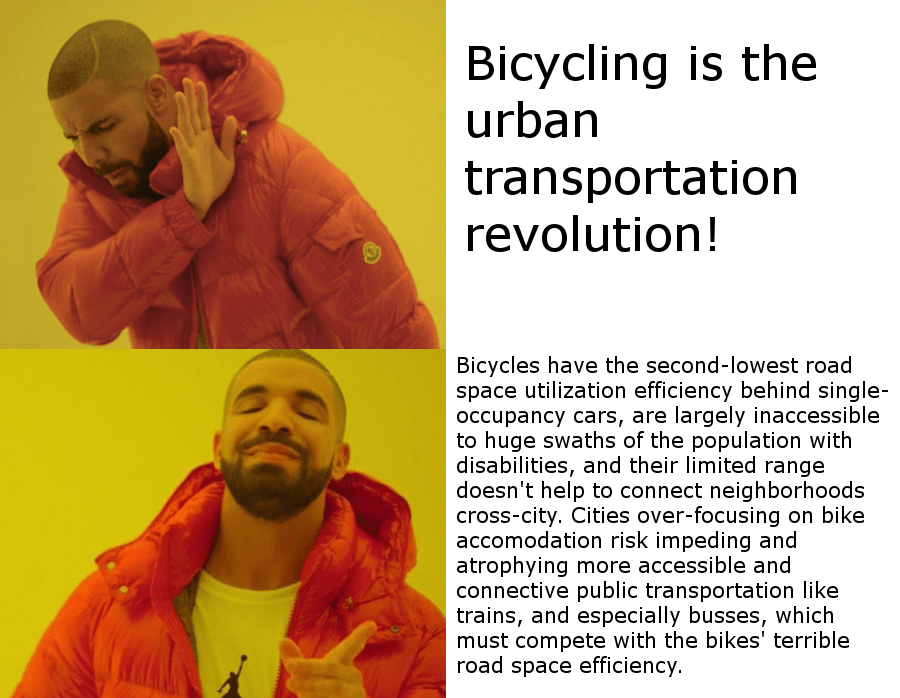
only for people who think traffic is caused by “not enough road”
traffic is a complicated phenomenon. on one level, it is caused by complex sociological and psychological interactions of many different people, who each dictate the movements of heterogeneous particles in the system.
on the other hand, it still has an upper bound governed by the same properties that govern all other flowing particles. the flux is still equal to the density times the cross sectional area times the velocity. and there’s actually even less wiggle room for traffic, because increasing velocity decreases density. (follow distance.) usually we think of that equation in three dimensional contexts, like with electricity and water, but it still applies in two dimensions, the units just go down a length dimension for density and cross-sectional area (which really becomes a length.)
0.11 cars per square meter (assuming lanes of 3.7m, square cars, and a follow distance of one car length – it’s a liberal estimate) times 11.1m (three lanes) times 13.4m/s is always the exact same 16.3 cars per second hard upper bound. that’s assuming people are following each other at one car length at 30mph, which is already very unsafe (but common in cities). the best people density you can get out of that is 65 people/s, with four people in each car.
you can preach all you want about the complexities of traffic. doesn’t matter. that’s a hard upper bound. the math will not allow you to surpass it. you can certainly fall short of it, but you won’t be getting past it.
if your road needs to carry more people than 65 people/s, what do you do? i mean, you’re already in an impossibly good situation, everyone’s driving with 3 passengers.
you can’t make it better by increasing velocity, because follow distance kills your gains. all you can do is increase the size of the road (not usually a good option), increase the vehicles per area (difficult – bikes are your only option, and for many reasons, they suck ass, mostly because the reduction in people per vehicle kills your gains) or increase the people per vehicle.
turns out that a few giant vehicles with people packed tightly give you better people/area than a bunch of tiny vehicles with one person each. who would have thought, it’s almost like the mathematical property of solids that their surface area to volume ratio decreases with size applies to vehicles. huh.
so, yeah. someone who drives a single-occupancy car switching to a bike will certainly help your traffic situation. someone who carpools switching to a bike will not. and most likely, those people don’t live in the city, so they won’t be switching no matter what you do.
the more important distinction is whether city residents bike or bus. and when you compare a bike to a bus… there is no comparison. bikes suck ass. the space occupied by a handful of bicyclists could be carrying 60 people, and increasing your traffic flux correspondingly. plus the bus is less likely to mow over pedestrians and smell like too much axe. it’s a win-win.
but, importantly, you’ll notice that my post didn’t only cite busses, nor did it only cite competition for finite vehicle flux. it alluded to atrophy. to MONEY.
city governments are notoriously poor, for a myriad of reasons, many of which tie directly into institutionalized racism. they only have so much money to spend on public transportation, and how they spend it is important, because effective public transportation is the thing that they need for internal growth – getting residents working and shopping in the city, keeping the wealth in the city as opposed to in the surrounding suburbs.
and all those bike lanes that are kind of stupid anyway because they get interrupted with a right turn lane at every intersection? they don’t just cost road space, they cost money. especially the ones with the cutesy little rocks that make it impossible to plow them in the snow. (congrats, you went from “normal bike lane that i have year round” to “slightly safer bike lane that stops existing for three months out of the year.”)
that money could be diverse bus routes, it could be more trains on the tracks, it could be subsidized ticket costs for both. but some cities instead spend it on helping hipsters go between two very-close points on the map.
it’s not just literal capital either, it’s social and political capital. bikes are great for localized transit – it is tremendously easy to throw a bunch of bike resources at people with institutional power (read: white hipsters) and then they won’t bother you to install any more public transit. majority black and hispanic people who live in impoverished neighborhoods, which don’t have any jobs or decent grocery stores within biking distance, so they can only use the bus? they’ll get screwed over, but won’t have the institutional power to challenge it.
bikes are a very useful tool for quelling political momentum for public transit. and so it’s critical to fight back – to say “no, these are not a solution for people who live outside of select neighborhoods where the resources are within biking distance. these fucking suck. fuck you, make more bus routes and build new rail.”
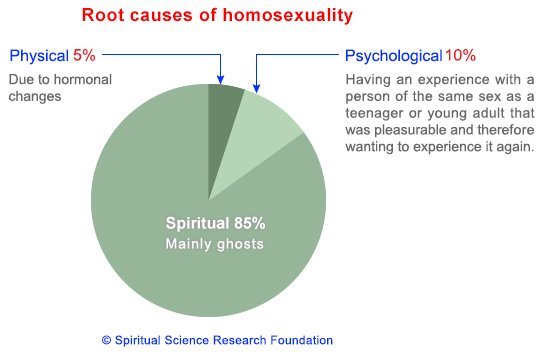
the best part of this image is that the website it’s from is dead fucking serious
I found the page and it’s better than I could have even imagined. apparently lesbians are possessed by male ghosts that cause attracted to women and gay men have female ghosts. Also this line:
“Spiritual research has shown that the cause for homosexual preferences lie predominantly in the spiritual realm.”
Part of me wishes it did have a citation
WAIT FUCK THERE”S MORE
Reblog if your homosexuality was a slippery slope to your interest in murder
I feel like this gives more merit to tagging pics of celebrity crushes “RIP me”
elementary school: reads at a middle school level
middle school: reads at a high school level
high school: reads at a college level
college: re-reads Harry Potter
for his second Magnus Chase book, due to the inclusion of the character Alex Fierro who is gender fluid. This was the speech he gave, and it really distills why I love this author and his works so much, and why I will always recommend his works to anyone and everyone.
“Thank you for inviting me here today. As I told the Stonewall Award Committee, this is an honor both humbling and unexpected.
So, what is an old cis straight white male doing up here? Where did I get the nerve to write Alex Fierro, a transgender, gender fluid child of Loki in The Hammer of Thor, and why should I get cookies for that?
These are all fair and valid questions, which I have been asking myself a lot.
I think, to support young LGBTQ readers, the most important thing publishing can do is to publish and promote more stories by LGBTQ authors, authentic experiences by authentic voices. We have to keep pushing for this. The Stonewall committee’s work is a critical part of that effort. I can only accept the Stonewall Award in the sense that I accept a call to action – firstly, to do more myself to read and promote books by LGBTQ authors.
But also, it’s a call to do better in my own writing. As one of my genderqueer readers told me recently, “Hey, thanks for Alex. You didn’t do a terrible job!” I thought: Yes! Not doing a terrible job was my goal!
As important as it is to offer authentic voices and empower authors and role models from within LGBTQ community, it’s is also important that LGBTQ kids see themselves reflected and valued in the larger world of mass media, including my books. I know this because my non-heteronormative readers tell me so. They actively lobby to see characters like themselves in my books. They like the universe I’ve created. They want to be part of it. They deserve that opportunity. It’s important that I, as a mainstream author, say, “I see you. You matter. Your life experience may not be like mine, but it is no less valid and no less real. I will do whatever I can to understand and accurately include you in my stories, in my world. I will not erase you.”
People all over the political spectrum often ask me, “Why can’t you just stay silent on these issues? Just don’t include LGBTQ material and everybody will be happy.” This assumes that silence is the natural neutral position. But silence is not neutral. It’s an active choice. Silence is great when you are listening. Silence is not so great when you are using it to ignore or exclude.
But that’s all macro, ‘big picture’ stuff. Yes, I think the principles are important. Yes, in the abstract, I feel an obligation to write the world as I see it: beautiful because of its variations. Where I can’t draw on personal experience, I listen, I read a lot – in particular I want to credit Beyond Magenta and Gender Outlaws for helping me understand more about the perspective of my character Alex Fierro – and I trust that much of the human experience is universal. You can’t go too far wrong if you use empathy as your lens. But the reason I wrote Alex Fierro, or Nico di Angelo, or any of my characters, is much more personal.
I was a teacher for many years, in public and private school, California and Texas. During those years, I taught all kinds of kids. I want them all to know that I see them. They matter. I write characters to honor my students, and to make up for what I wished I could have done for them in the classroom.
I think about my former student Adrian (a pseudonym), back in the 90s in San Francisco. Adrian used the pronouns he and him, so I will call him that, but I suspect Adrian might have had more freedom and more options as to how he self-identified in school were he growing up today. His peers, his teachers, his family all understood that Adrian was female, despite his birth designation. Since kindergarten, he had self-selected to be among the girls – socially, athletically, academically. He was one of our girls. And although he got support and acceptance at the school, I don’t know that I helped him as much as I could, or that I tried to understand his needs and his journey. At that time in my life, I didn’t have the experience, the vocabulary, or frankly the emotional capacity to have that conversation. When we broke into social skills groups, for instance, boys apart from girls, he came into my group with the boys, I think because he felt it was required, but I feel like I missed the opportunity to sit with him and ask him what he wanted. And to assure him it was okay, whichever choice he made. I learned more from Adrian than I taught him. Twenty years later, Alex Fierro is for Adrian.
I think about Jane (pseudonym), another one of my students who was a straight cis-female with two fantastic moms. Again, for LGBTQ families, San Francisco was a pretty good place to live in the 90s, but as we know, prejudice has no geographical border. You cannot build a wall high enough to keep it out. I know Jane got flack about her family. I did what I could to support her, but I don’t think I did enough. I remember the day Jane’s drama class was happening in my classroom. The teacher was new – our first African American male teacher, which we were all really excited about – and this was only his third week. I was sitting at my desk, grading papers, while the teacher did a free association exercise. One of his examples was ‘fruit – gay.’ I think he did it because he thought it would be funny to middle schoolers. After the class, I asked to see the teacher one on one. I asked him to be aware of what he was saying and how that might be hurtful. I know. Me, a white guy, lecturing this Black teacher about hurtful words. He got defensive and quit, because he said he could not promise to not use that language again. At the time, I felt like I needed to do something, to stand up especially for Jane and her family. But did I make things better handling it as I did? I think I missed an opportunity to open a dialogue about how different people experience hurtful labels. Emmie and Josephine and their daughter Georgina, the family I introduce in The Dark Prophecy, are for Jane.
I think about Amy, and Mark, and Nicholas … All former students who have come out as gay since I taught them in middle school. All have gone on to have successful careers and happy families. When I taught them, I knew they were different. Their struggles were greater, their perspectives more divergent than some of my other students. I tried to provide a safe space for them, to model respect, but in retrospect I don’t think I supported them as well as I could have, or reached out as much as they might have needed. I was too busy preparing lessons on Shakespeare or adjectives, and not focusing enough on my students’ emotional health. Adjectives were a lot easier for me to reconcile than feelings. Would they have felt comfortable coming out earlier than college or high school if they had found more support in middle school? Would they have wanted to? I don’t know. But I don’t think they felt it was a safe option, which leaves me thinking that I did not do enough for them at that critical middle school time. I do not want any kid to feel alone, invisible, misunderstood. Nico di Angelo is for Amy, and Mark and Nicholas.
I am trying to do more. Percy Jackson started as a way to empower kids, in particular my son, who had learning differences. As my platform grew, I felt obliged to use it to empower all kids who are struggling through middle school for whatever reason. I don’t always do enough. I don’t always get it right. Good intentions are wonderful things, but at the end of a manuscript, the text has to stand on its own. What I meant ceases to matter. Kids just see what I wrote. But I have to keep trying. My kids are counting on me.
So thank you, above all, to my former students who taught me. Alex Fierro is for you.
To you, I pledge myself to do better – to apologize when I screw up, to learn from my mistakes, to be there for LGBTQ youth and make sure they know that in my books, they are included. They matter. I am going to stop talking now, but I promise you I won’t stop listening.”











 callanswall