micdotcom:

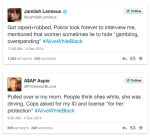
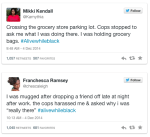
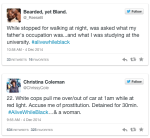
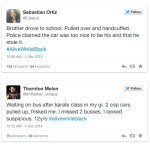
#AliveWhileBlack is the heartbreaking response to #CrimingWhileWhite

The hashtag #CrimingWhileWhite became a platform to illustrate what often happens when white people engage in criminal activity. It was a powerful moment, as white people openly acknowledged that they don’t face nearly the same punishment or brutality experienced by their black counterparts. But despite the good intentions of those who participated, many others felt like the hashtag detracted from conversations about the value of black lives.

In response to that first trending hashtag, Jamilah Lemieux, senior digital editor for Ebony magazine, started #AliveWhileBlack.

Voyager is so happy, because it’s the bravest satellite of all. It has gone the furthest. And it’s not lonely, because it’s talking to us. It phones home. And it tells us all about the wonderful things that it’s seeing. …There’s a whole universe to explore, and it’s just leaving our Solar System right now. It’s very brave and very lucky to be doing what it’s doing, so it’s not going to get lost. It’s traveled further than anything we’ve ever built has traveled before. It’s actually showing us the way. …

It might have been safer for it to just stay home, and stay inside a building, but then it would have been sad forever, because it never would have done its purpose. It never would have discovered things. It’s all a wonderful story of great discovery and success, and it couldn’t have happened if Voyager hadn’t been brave…

It’s not really the fact that everything always has a start and an end, it’s what happens in the middle that counts. What do you while you’re alive? What do you do while you’re laughing? And I think we’re doing exactly what makes Voyager joyful and as happy as it could be.

Think about the fact that you’re a little bit like Voyager. In that you’re going to go see the world, and you’re going to call your mom on the phone and tell her about the wonderful things that you see. … You wouldn’t want to spend your whole life hiding under your bed and never seeing anything in your whole life, you want to be able to do what makes you happy and joyful and learn about things to discover. You might be the person that discovers something really important for everybody else on the world, but you can never discover that if you just hide and only do things that are safe. So think about yourself a little bit like Voyager. What makes you laugh? It’s not just staying, hiding underneath your bed safely at home.

Cmdr. Chris Hadfield, reassuring a five-year-old who was worried about the Voyager satellite (source)

(via reconditarmonia)

And as a recovering grammar snob myself – please don’t start about how I opened this article with a dangling preposition; it’s still bothering me – I understand the knee-jerk reaction to improper usage and mechanics.

I’m an editor, for God’s sake; I eat, sleep, and breathe correct comma placement.

But there’s a difference between understanding standard grammar and demanding it, between believing there’s a time and a place for so-called “proper” English and ridiculing anyone who steps outside of what you deem “acceptable.”

There’s a difference between appreciating language and being a snob.

And the last place that we need grammar snobbery is in social justice movements.

And not just because getting hung up on the correct use of homonyms or subject-predicate agreement is distracting to the job at hand, but also because purporting one form of English as elite is inherently oppressive. …

As educated (and – okay – snarky) activists, we’re quick to respond to “According to the dictionary” arguments with “Who wrote the dictionary, though?”

We understand that a reference guide created by a white supremacist, heteropatriarchal system does nothing but uphold that status quo.

Similarly, we have to use that line of thinking when talking about the English language: Who created the rules? And who benefits from them?

As per usual, what this comes down to is an issue of privilege (of course!). In fact, grammar snobbery comes down to an intersection of multiple privileges.

Let me count the ways.

Why Grammar Snobbery Has No Place in the Movement

The whole thing is very much worth the read, but here’s a list of the privileges from the article that intersect with ideas of “correct” grammar: 

1. Educational Privilege 
2. Class Privilege
3. Race Privilege
4. Native Language Privilege
5. Ability Privilege

Also relevant is the idea of literacy privilege

republiccitysanctuary:

gothiccharmschool:

brainvomit:

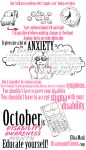
In case you didn’t know, October is learning disability awareness month! Also, you probably didn’t know I have one, since the general reaction I tend to get is “you don’t /look/ like you have a learning disability”.

That’s partially why I made this, because people seem to think you’re branded with it on your forhead when in real life it’s not like that at all—In fact, that mentality is probably what hurt my academic career for so long, because people with Dyscalculia often excel in other areas! I remember a lot if teachers/classmates/my own parents telling me to ‘just try harder’, because to them it seemed like I wasn’t applying myself. Dyscalculia is also not a ‘popular’ learning disability that’s talked about, it’s a pretty common occurance for me to have to give an explanation to others who think I’m ‘lazy’, so I figured this is a little educational as well as personal.

Those with Dyscalculia have trouble with*:

•Counting, estimating, and measuring. •Learning math facts (like addition, subtraction, multiplication, ect). •Problem-solving skills. •Concepts of time and navigation (scheduling, telling the diffrence between directions). *Among other things, but those are the most common.

●Here are some Dyscalculia resources:
•Learning Disability Association of America- [ldaamerica.org/types-of-learning-disabilities/dyscalculia]
•National Center for Learning Disabilities- [ncld.org/types-learning-disabilities/dyscalculia/what-is-dyscalculia]
•Dyscalculia.Org

●Think you have Dyscalculia? Test yourself (Don’t self-diagnose, bring your results to your parent/school counselor/therapist and discuss further testing)
•[cohenkadosh.psy.ox.ac.uk/test-yourself/are-you-dyscalculic]

I did not know that Dyscalculia was a diagnosis that existed until a few years ago. Once I knew, it felt like I was aiming a flashlight back at my school career, finally able to see some things clearly. Ask me to read a novel and write a term paper overnight? Sure, no problem. Ask me to do a times table? Blind, near-sobbing panic. 

Even now, if I have to do basic multiplication, if it’s not something that had a song from Schoolhouse Rock, I … I’m not sure I can do it.

Wow, I had no idea this was even a thing. Reblogging for education.