
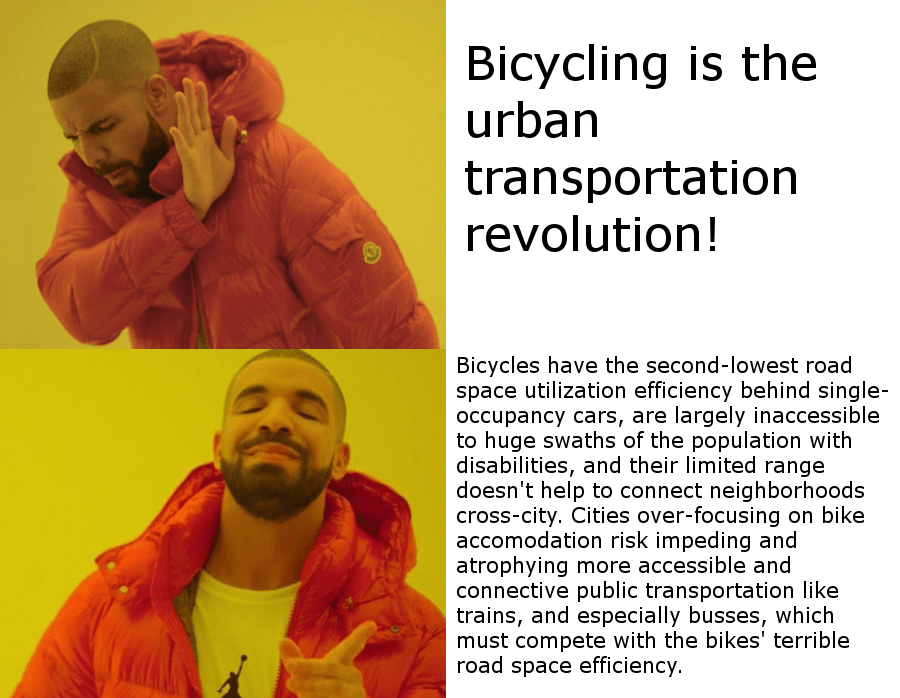
Is road-space efficiency really the only concern?
only for people who think traffic is caused by “not enough road”
traffic is a complicated phenomenon. on one level, it is caused by complex sociological and psychological interactions of many different people, who each dictate the movements of heterogeneous particles in the system.
on the other hand, it still has an upper bound governed by the same properties that govern all other flowing particles. the flux is still equal to the density times the cross sectional area times the velocity. and there’s actually even less wiggle room for traffic, because increasing velocity decreases density. (follow distance.) usually we think of that equation in three dimensional contexts, like with electricity and water, but it still applies in two dimensions, the units just go down a length dimension for density and cross-sectional area (which really becomes a length.)
0.11 cars per square meter (assuming lanes of 3.7m, square cars, and a follow distance of one car length – it’s a liberal estimate) times 11.1m (three lanes) times 13.4m/s is always the exact same 16.3 cars per second hard upper bound. that’s assuming people are following each other at one car length at 30mph, which is already very unsafe (but common in cities). the best people density you can get out of that is 65 people/s, with four people in each car.
you can preach all you want about the complexities of traffic. doesn’t matter. that’s a hard upper bound. the math will not allow you to surpass it. you can certainly fall short of it, but you won’t be getting past it.
if your road needs to carry more people than 65 people/s, what do you do? i mean, you’re already in an impossibly good situation, everyone’s driving with 3 passengers.
you can’t make it better by increasing velocity, because follow distance kills your gains. all you can do is increase the size of the road (not usually a good option), increase the vehicles per area (difficult – bikes are your only option, and for many reasons, they suck ass, mostly because the reduction in people per vehicle kills your gains) or increase the people per vehicle.
turns out that a few giant vehicles with people packed tightly give you better people/area than a bunch of tiny vehicles with one person each. who would have thought, it’s almost like the mathematical property of solids that their surface area to volume ratio decreases with size applies to vehicles. huh.
so, yeah. someone who drives a single-occupancy car switching to a bike will certainly help your traffic situation. someone who carpools switching to a bike will not. and most likely, those people don’t live in the city, so they won’t be switching no matter what you do.
the more important distinction is whether city residents bike or bus. and when you compare a bike to a bus… there is no comparison. bikes suck ass. the space occupied by a handful of bicyclists could be carrying 60 people, and increasing your traffic flux correspondingly. plus the bus is less likely to mow over pedestrians and smell like too much axe. it’s a win-win.
but, importantly, you’ll notice that my post didn’t only cite busses, nor did it only cite competition for finite vehicle flux. it alluded to atrophy. to MONEY.
city governments are notoriously poor, for a myriad of reasons, many of which tie directly into institutionalized racism. they only have so much money to spend on public transportation, and how they spend it is important, because effective public transportation is the thing that they need for internal growth – getting residents working and shopping in the city, keeping the wealth in the city as opposed to in the surrounding suburbs.
and all those bike lanes that are kind of stupid anyway because they get interrupted with a right turn lane at every intersection? they don’t just cost road space, they cost money. especially the ones with the cutesy little rocks that make it impossible to plow them in the snow. (congrats, you went from “normal bike lane that i have year round” to “slightly safer bike lane that stops existing for three months out of the year.”)
that money could be diverse bus routes, it could be more trains on the tracks, it could be subsidized ticket costs for both. but some cities instead spend it on helping hipsters go between two very-close points on the map.
it’s not just literal capital either, it’s social and political capital. bikes are great for localized transit – it is tremendously easy to throw a bunch of bike resources at people with institutional power (read: white hipsters) and then they won’t bother you to install any more public transit. majority black and hispanic people who live in impoverished neighborhoods, which don’t have any jobs or decent grocery stores within biking distance, so they can only use the bus? they’ll get screwed over, but won’t have the institutional power to challenge it.
bikes are a very useful tool for quelling political momentum for public transit. and so it’s critical to fight back – to say “no, these are not a solution for people who live outside of select neighborhoods where the resources are within biking distance. these fucking suck. fuck you, make more bus routes and build new rail.”
 callanswall